Monday, December 21, 2015

"My name is in America"

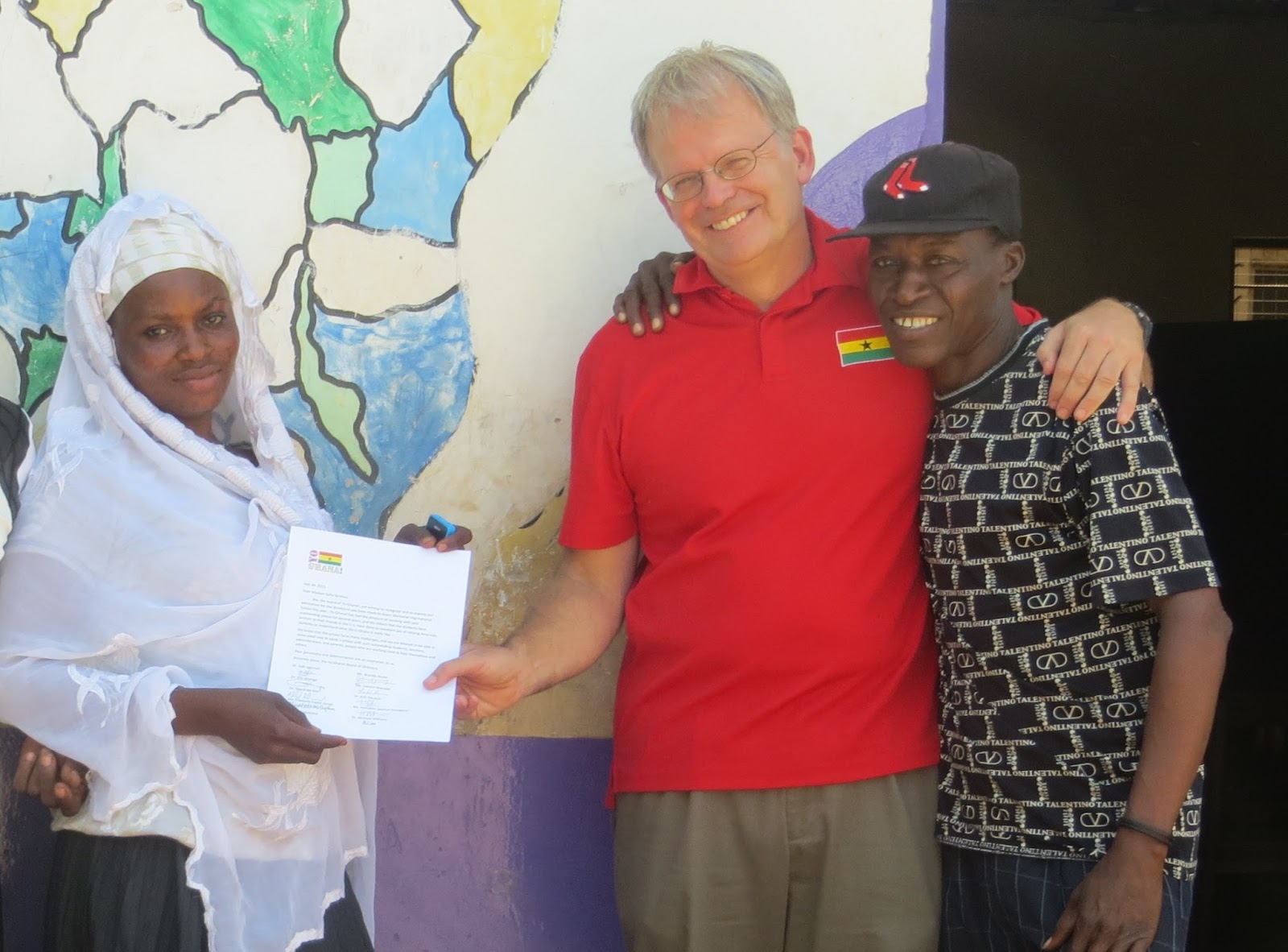
There is a bit of a back story to this photograph, taken four months ago at Anani Memorial International School.

I met Mr. Abdullah four years ago.  He has taught French at the school for close to forty years.  He is one of the most dedicated and energetic educators I have ever met.

Anani School is a small private school that serves the children of many struggling families in the slum of Nima.  The parents often make about $2.00 a day, and many of the pupils are orphans who are being raised by grandparents or others.  Parents make big sacrifices to send their children to this school, as the available public schools are overwhelmed.  But they are not always able to pay the fees, so the school often struggles and the teachers, such as Mr. Adbullah, often suffer.

We believe strongly that Yo Ghana! should always help in a way that encourages local initiative, so our board decided that the best way to assist the school was to ask parents and other community members to donate goods (such as onions) or services (such as music lessons) to the school, and we would match their contributions with cash.

The project was very successful.  It not only raised goods and services and money for the school, it also increased parents' pride in and commitment to it, and they loved the certificates.  Madam Samira says that she hung hers in her room "so that I can see it every morning and tell myself to contribute more because my name is in America."

I tell  you this story because I think it illustrates how careful we are with the money that you donate to us, and how hard our partners in Ghana work to do their part, often against great odds, in giving their children and their students a chance at a better life.

We are trying to raise $5,000 in December, about 25% of our budget for the coming year.  So far we have raised $1,100, so we need your help.

To contribute, just to to http://www.yoghana.org/donate.html -- or e-mail yoghana.org@gmail.com and ask for my mailing address.  As we are a 501(c)3, deductions are tax deductible.

Thursday, December 17, 2015

The Secret About Mormons

I recently ran across an article on how Utah is attacking homelessness in Mother Jones, the radical
magazine, that reminded that educated people like me are often blind to all the good things that conservative churches and people are doing.

Mention the word "Mormon" or "Utah" around most well-educated liberals, and you'll soon be hearing about their sexism, racism, intolerance toward gays, and all manner of other cruelties.

If you happen to be one of those rare liberals who actually has some Mormon friends, you might notice that they tend to be very family oriented and generous.

Now Mother Jones tells us that one of the reasons that Utah has done such a fine job of reducing homelessness is that they have drawn on the Mormon principle of charity.  Rather than insisting that someone first get sober, drug free, and otherwise get their lives in order before getting shelter, it turns out that once homeless people have a home, they have a much easier time fixing the rest of their problems, so much so that it is costs less to give homeless people a home than it does to deal with all of their problems while they are living on the street.

In this world in which radicals, liberals, and conservatives are so often insulting rather than listening to each other, I find it pretty cool that Mother Jones is pointing out some excellent and humane work coming out of Utah and the Church of Latter Day Saints.

So I invite you to seek out some good news about a group whose politics or theology makes you uncomfortable.

Friday, December 11, 2015

Surviving My Teen Years in the 1970s

The image to the right is from "Dazed and Confused," a widely beloved film of high school in the mid-1970s.  Having been in high school in the mid-1970s, I find the film all-too realistic and therefore not all that funny.  I think the problem is that the film implies that being stupid and rebellious was some sort of achievement and without repercussions.  The film doesn't present the lives of people like my classmate who tried every way he could think of to be cool without success until he finally settled on his route to fame: taking more drugs than anyone else.  The end of that gambit was not funny.

I found high school both boring and frightening.  I was completely clueless about how to connect to young women, especially the ones I found attractive, but also put off by the continual stream of sexual harassment that the school tolerated.  Taking a strong interest in academics never seemed like a viable option for some reason.  I don't know if that was because that's the stage I was in or because so few adults or certainly students seemed all that interested in it.  I wasn't into drinking (partying), so that seemed to be a barrier.  Distance running ended up being my "thing," and gave me a small set of friends and certainly a strong sense of purpose.

It's interesting, though, now that I'm spending more time with the people I went to school with to find out how much I enjoy them, and it makes me wonder why I couldn't have been less rigid and frightened and judgmental as a teen and made more friends and gotten a better sense of what the world was like.  It felt like years to survive, not explore.

Thursday, December 3, 2015

Inspiring Book: Find Me Unafraid

I recently read a particularly inspiring book: Find Me Unafraid: Love, Loss, and Hoe in an African Slum. by Kennedy Odede and Jessica Posner.

The authors met in Kibera, the extensive slum in Nairobi, Kenya.  Kennedy and was a home-grown community organizer who had overcome poverty and a tumultuous home life to become a powerful community member.  How poor was the group who got the community group started?  Well, they had just one pen to write notes.

Jessica was an idealistic and strong-willed university student from the U.S. spending a semester in Nairobi who told Kennedy that she was going to take the highly unusual step, for a westerner, of living in Kibera.  Find Me Unafraid explains how they worked together, became married, and, with the help of many other, have built a school for girls and many other institutions and services.

Two things I like about this book: First) The authors present themselves as partners.  Jessica has a lot more formal education and wealth than Kennedy does, but Kennedy is rich in life and leadership experience.  Second) The organization at the heart of the story was started by a group of slum residents who had just a pen--and a lot of determination.  They didn't wait for a Western NGO.

Friday, November 20, 2015

Yo Ghana! and (Real and Imagined) Terrorism

Whenever Americans perceive there to be a threat from abroad, from Ebola to terrorism, we tend to panic.  This occurs even though the odds of being killed by a terrorist--or Ebola--in the U.S. are infinitesimally small.

Indeed, some people argue that our reaction to threats of terrorism may create more terrorists than it eliminates.  This is not just about drone attacks that anger people by killing the innocent along with the guilty.  It also has to do with the belief that Americans are only interested in our own well being, are indifferent to the rest of the world.  And in fact terrorism can easily make Americans so afraid of "people different from us" that we make bad and cruel decisions.  Today most every historian and legal scholar concludes that the internment of Japanese-Americans curing World War II was not only inhumane and illegal, , it also hurt more than it helped the war effort.  But very few voices were raised against it at the time.

So, what does this have to do with Yo Ghana! and Ghana, a place were terrorism and other forms of violence are rare?

First, many of our Ghana schools provide hope to families who might otherwise give up.  Turning to violence and crime is commonly a last resort, when working hard and playing by the rules seems like a fool's game.  Hope depends on institutions that offer hope.

Second, administrators, teachers, and students in Ghana also tell us that having a friend in the U.S. and being visited by Yo Ghana! is a sign of respect.  America is often viewed as a sort of utopia, where everyone is rich and happy--but also as a place that does not care much about the rest of the world.  Letters and visitors from America challenge that stereotype.

Third, American students' fears of the unknown, the alien are dissolved by the warmth and consideration communicated through the letters they receive from Ghanaians, many of whom are Muslim.  Hollywood and our news media often portray Africans and Muslims as threats.  It is hard to feel threatened by someone who writes to tell you that he is praying for your family or that she hopes you can visit her home some day.

When we visit classrooms in Ghana and the the Pacific Northwest we tell students that we need them for important work not after they graduate from graduate school, college, high school, or their present grade level, but right now.  We need them to tell each other what life in their country is really like and to show the rest of us how to know and respect each other.

Friday, November 13, 2015

Welcome, Komi Kalevor, and Thank You, Leeann Bronson

The board of Yo Ghana! is delighted to welcome aboard Mr. Komi Kalevor, who has not only accepted our offer to join the board but is also assuming the Treasurer position. 

Komi moved to the U.S. from Ghana in the early 1980s and earned an MBA at Willamette University.  He has worked for many years in a variety of management positions in housing development finance, program management, and banking, including many years with the Portland Development Commission.  He is currently the Assistant Director of the Housing Authority of Washington County.  He has served on the boards of Portland Habitat for Humanity Metro West, the Portland Guadalajara Sister City Association, Portland Community Reinvestment Initiatives, the PSU Alumni Association, and the Ghana Association of Oregon.


Komi joined us “to do my part to help Yo Ghana! achieve its mission, which I am in full agreement with,” for “meaningful cultural exchanges can go a long way to break down barriers and serve to educate today's youth to be become 'citizens of the world.'”  In fact Komi himself participated in a high school student exchange program between Ghana and Oregon in the late 1970s, so at a young age he was living out our slogan: exchanges for transformation, was doing Yo Ghana! four decades before there was a Yo Ghana!


Komi and his wife, Judith, reside in Vancouver, Washington.  Son Selali, is a senior at Washington State University, Pullman, daughter Shika a sophomore at Seattle University.

Our board is saying farewell to one of its first members, Ms. Leeann Bronson. 

Leeann joined our board more than two years ago, before we became a 501(c)3, and immediately began serving as our Treasurer, a crucial position that is notoriously difficult to fill.  She never missed a meeting or a deadline.

I think what inspires me most about Leeann is that she stepped forward to do crucial and demanding work for an organization that she had no particular attachment to.  She had never been to Ghana or had an interest in letter exchanges.  But in her unassuming way she became passionate about our work and was one of our rocks.

We are most grateful, Leeann.


Friday, November 6, 2015

Brando's Seamless Faith

Part of what I most appreciated about Brando Akoto, my dear friend and Yo Ghana! board member who passed away barely a week ago,  was how he lived out his faith.  Like many
educated people in the U.S., I'm wary of discussing religious beliefs in a general forum like this.  Being a Christian is, I hope, at the center of my own life, but I work for a secular institution and head up a secular nonprofit.  And I notice that many people flinch at the mention of Christianity or faith, fearing--often with good cause--that Christians are prone to "trying to ram their religion down people's throats."

But I'm going to plunge ahead precisely because Brando was so comfortable living out a faith that was fundamental to who he was, and doing so with great consideration and respect for others.

I never sensed that Brando drew a distinction between his religious and public life.  Like many Christians from West Africa, he emphasized the healing and forgiving power of Christ's blood.  But Jesus was both example and redeemer to him.  Like St. Francis, he believed that Christians should "preach the gospel at all times, and when necessary use words."  With God's grace came a call to put one's life at God's disposal.  For Brando, that meant showing love and care to everyone he met as well as battling more abstract evils such as poverty, ignorance, hopelessness, racism, and other forms of oppression.  He gave himself to others with a sort of Christ-like recklessness.  I once asked him why he was devoting so much of his time to Yo Ghana!  He replied, "Prof., you give me no choice."  I took this to mean that he believed that if you saw someone doing something you respected, you were obligated to help her or him.  It did not matter how tired you or how many items there were on your "to do" list. Certainly he never seemed too tired to help a friend or a stranger, from spending three weeks of his vacation visiting schools in Ghana to encouraging a street vendor to do better in school.

Brando was a powerful speaker, inside and outside of church, and no one has been more important than him in drawing me into a deeper Christian commitment.  But his most compelling sermon was his life, a compelling witness of what a redeemed life, a soul on fire looks like.

I wonder what Christianity would look like and how Christians might be viewed if we expressed our faith as he did?